Nathan Mayer Rothschild, the oldest of the five Rothschild brothers who established the venerable commercial bank in the late eighteenth and early nineteenth centuries, is said to have remarked, "I never buy at the bottom and I always sell too soon." This sentiment is echoed by the American financier (I believe it was JP Morgan), who, when presented with an investment offering 100% returns, remarked, "Well, you can have the first 30% and the last 30% and I will just take the nice safe 40% in the middle." In other words, he wasn´t interested in buying before he was certain that the return would be positive.
I have recently read that the essence of investing is not managing returns, it´s managing risk. First you want to be reasonably sure of a positive return (capital preservation), only then do you want to consider the potential magnitude of the returns. Too many people look at the magnitude of returns first, and only then consider the probability of achieving these returns. This is why the lottery is so popular - it offers a huge return, for essentially nothing. Of course, most purchasers are simply incapable of appreciating the remoteness of the probability that their return will be positive. So they lose 100% every week, occasionally winning a minor pot of $5 or $10 to desensitize them to the dififculty of the odds they face.
This post isn´t about the lottery, however, it´s about TRLG. I mentioned in a prior post that I had left the temple of True Religion. Actually, I left a few weeks too early. I sold at $22.60 on a day when the high price for the day was §22.80. A few weeks later, the stock actually made new all-time highs in the $24.65 range. I lost out on an extra $800 by "selling too soon". But as my calculations from my DCF model suggested, the stock was near its highs at $22.60, and the probability of further gains were remote. Earnings would have to rise even faster than the 50% I projected for this year (35% for next), or operating margins would have to increase. While the first event was possible, I held out no expectations of the latter.
I work for a manufacturer. Like all companies with independent distribution, we regularly consider whether we wouldn´t be better off if we could capture more downstream revenue. Since pricing is usually based on cost-plus margining, capturing retail sales would significantly increase revenue, without actually capturing market share (we would benefit from selling at the retail price, which , for spare parts, is usually 65-100% greater than the wholesale price). The problem is that in order to do this, we would also have to absorb retail inventory, which would significantly increase working capital. We would also have to pay the expenses at retail that the distributors bear, personnel, rent and overhead. Worse, as a manufacturer, we would only really have one product line, whereas most distributors can amortize expenses over a wider product assortment available to them (since they can sell products from many manufacturers). This is essentially the difference between a specialty retailer and a department store. The department store also finds it easier to attract new customers, since it can easily cross-sell shoppers in the store for other promotions or products.
In fact, what we have begun to see from True Religion is that sales outside of the US are flagging, or at least, not increasing. Sales in the US are increasing, but primarily due to growth in the retail segment (i.e. the company is capturing that downstream revenue). However, this means that revenue is increasing faster than product volume, which raises serious questions about the acceptance of the brand on a broader scope. Worse, they are seeing increasing overhead, which management insists is required for future product introductions, but managing a retail chain is difficult. The company has brought in experience for this. The current management team has demonstrated success with retail, but what we are seeing is collapsing operating margins. For a company whose primary value is in future earnings, lower operating margins have to terrify investors.
In fact, while I was in Mexico on a business trip (I was in the buffett line at lunch actually), two other attendees started talking about the collapse of the stock price of TRLG, which has since declined to the mid $15 range. At this price, you might very well be able to round-trip the stock back up to $20, if management can find the new revenues to justify the ramp-up in expenses. But for the first time, management has failed to deliver the goods and so their ability to win converts on the street will come much harder.
At this point, I am sitting on lots and lots of cash. Buffett notes that this is no fun, and I concur, but at the same time, its better to sit on cash than watch your positions collapse. I am still looking for another investment that I find as attractive as TRLG. Right now, the only investment I consider worthwhile is BAC. I am even beginning to doubt the CL. Since I purchased in October 0f 2004, I have watched the stock price rise 50%, from $44 to $66, at the same time, I have earned nice dividends, which have been hiked twice, from 24 cents to 32 cents a share (for a 33%) increase over the same period. My shareholdings have increased by nearly four percent, giving me a total return of over 56% for the period (If you are wondering why my return isn´t 54%, the sum of the two, the reason is that the shares purchased from dividend reinvestment have also benefitted from rising prices, so my total return exceeds the price increase plus dividend payments).
Generally speaking, your return should reflect the dividend yield plus the rate of increase of dividends. (I have another post explaining why this is so, but essentially, with dividend paying stocks, prices tend to increase at the same rate as dividend increases). With CL price increases have outstripped dividend increases, so the dividend yield has fallen. This suggests lower returns going forward. Indeed, to return to the dividend rate of Oct 2004, when I purchased, dividends would have to increase about 17% or 5 cents per share, from here with no increase in the stock price. This would then offer a return of about 2.6% (the dividend yield at 37 cents per share, per quarter). Such a dividend increase is actually quite probable. The company tends to maintain a dividend payout ratio of around 50% of earnings, with much of the remaining money going to repurchase stock, both preferred and common. In the latest quarter the company earned $0.73 per share. With forward earnings expected to run about $0.80 per share per quarter the company could raise to 38-39 cents per share per quarter. Organic growth, plus benefits from the company´s restructuring make these very reasonable projections. But even with this strong dividend increase rate, the stock should have only moderate price appreciation. Of course, as I have suggested many times, I own the stock because it offers a reasonable return with a high degree of safety, but even stocks like KO can take big dives (granted, at its all-time high Coke was trading at a ridiculous 45 times earnings).
The real kicker with CL is that it trades at 27 times earnings, but that is before the stock is fully diluted. There are 39 million options on the stock. While repurchases are easily oustripping option issuance, redemptions and forfeits are reducing the overall stock of ourstanding options, but with all options exercised, the stock trades at over 30 times earnings. There have to be better options. Unfortunately I haven´t had the time to find them.
Sunday, November 19, 2006

Thursday, September 28, 2006
An offer from the Strategic Investor
A couple of people have contacted me about getting the excel sheet for the DCF analysis. You could also make one yourself, but why reinvent the wheel? The issue is, blogger isn't terribly helpful with sharing excel files (if someone knows how, please tell me), so I have to send via email. I ask that you subscribe to my feed by entering your email address in the the box at the right (just enter your email in the white box on the right hand side and then confirm via the email confirmation) and I will send you the file as an email attachment.
Wednesday, September 27, 2006
DCF for TRLG
In my last post, I mentioned a DCF (discounted cash flow model) for TRLG.
Unfortunately there was a problem with Blogger photos, so it didn't embed.
So, I will try again.
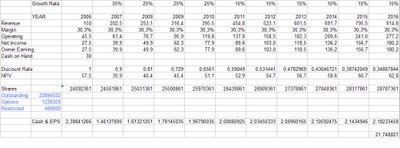
The model covers a ten year valuation of the company. Basically, what I have done is take the actual net cash and equivalents as of December 31, 2005, and the actual number of shares outstanding, plus the number of options outstanding, plus the number of restricted stock shares issued, and project the following: annual revenue growth, operating margins, tax rate, net income and owner earnings (net income plus depreciation less capital expenditures), and future equity dilution.
Starting with 2006, I project revenues of $150 million. This represents a 50% increase over last year's $102 million, and is roughly the amount that management projects. Going forward, I expect slower growth. It is possible that my growth rates are too conservative, but how mainstream can $300 jeans be? International sales are also flagging, though management has insisted that this will improve shortly. Management insists that it can turn the brand into a $1 billion per year business, though how long is not clear.
Next up is margins - a measure of how profitable those revenues are. The company appears to be consistently running an operating margin of 30.3%. It is important to distinguish between gross margins and operating margins. Gross margins is the spread between the sale price and the cost of the product sold, expressed as a percentage of the sale price. Thus, if sell for $300 a pair of jeans that cost you $150 to produce or purchase, your gross margin is 50%. However, there are still the other operating expenses, like employee, marketing, legal, and others, to pay. These are generally lumped together under Selling, General and Administrative expense. After you pay those expenses you arive at operating margins. That is, your profit as a percentage of sales after you have paid all operating expenses.
(Please note that the spreadsheet is in a German version of MS Excel, so don't be thrown by the commas. Germans use commas where US uses decimal points, and vice versa. Funny, isn't it? But I digress).
TRLG has benefitted from higher margins in recent months, expanding to about 52-53%. Most of this margin expansion is coming from the impact of retail stores, which enables the company to capture the additional gross profit between wholesale and retail. Unfortunately, it also means the company has proportionately higher selling, general and administrative expense, because there are rent, employees, utilities and other expenses to pay in operating that retail store, so operating margins are remaing about the same as before the retail stores. (The amount of revenue is higher, because revenue is now happening at retail, and not only at wholesale prices, so that margin is being earned on a higher top line number).
From there one has to consider interest expense (none, since the company has no debt, and appears to require no major investment to grow revenues, since all products are produced by contract manufacturers). This leads us to taxes. I assume a tax rate of 35% for all years. Here, I am simply projecting the current maximum corporate tax rate into the future. This is actually one area where I have not been conservative. It is likely that the US government will raise taxes, particularly on corporations, in the next 10 years, in order to combat rising deficits.
After the taxes are paid, we have Net Income. To this we need to add depreciation (a non-cash expense), and subtract capital expeditures. In mature businesses, these numbers are often very similar, as the business tends to need relatively little capital. What makes TRLG interesting is that it has virtually no cap-ex at all. In fact, it has virtually no long term capital commitments, other than some leasehold improvements at its corporate offices and retail stores.
So, Net Income and Owner Earnings are essentially the same.
The Discount Rate
One of the most crucial numbers you can chose in investing is an appropriate discount rate. The discount rate is used to reflect the time-value of money. Obviously, if I offered you $1 today or $1 in ten years, you would rather have the $1 today. I have to "discount" the value of the dollar in ten years to reflect the risks that you assume in waiting so long to get your money.
The first time they hear this, most people think of inflation, and in fact the idea is very similar. But where inflation measures the discount that would be required to maintain purchasing power, investors need to use a different number. We have to ask ourselves, what is the opportunity cost of the capital? Since if we didn't put our capital into this investment we could put it into a different one, we should really use a number that reflects what would happen if we were to earn the market return. I estimate this at about 10% (though in my first post I mentioned that the compounded rate of return of US stocks since 1926 is actually 9% - and that was in 1999 at the height of the bubble).
Once I have discounted those earnings into the future, I then need to divide the discounted earnings by the anticipated number of shares outstanding, so see how much earning power one share should have.
Thus far this year, management has cut out issuing itself options. Instead, it issues itself restricted stock. This year, the company issued employees 450,000 shares of restricted stock (it also issued some as settlement to outsiders). I see no reason to expect that management will become more frugal going forward, so I estimate the increase in shares outstanding by 469,000 per year. I then divide each year's discounted earnings by the anticipated shares outstanding.
All that is left to do is sum up the values. This produces a Net Present Value (reflecting the sum of all the present values) of the future cash flows of the company. Those cash flows are worth about $22.
Unlike most DCF models, I am assuming no residual value beyond the measurement period (generally, investments in stocks are considered to have infinite valuation periods, and you have to do that special calculation. In the case of this stock, where the true long term sustainability of the business is really a question it makes no sense to assume an infinite valuation period. The extra margin of safety is key).
Unfortunately there was a problem with Blogger photos, so it didn't embed.
So, I will try again.
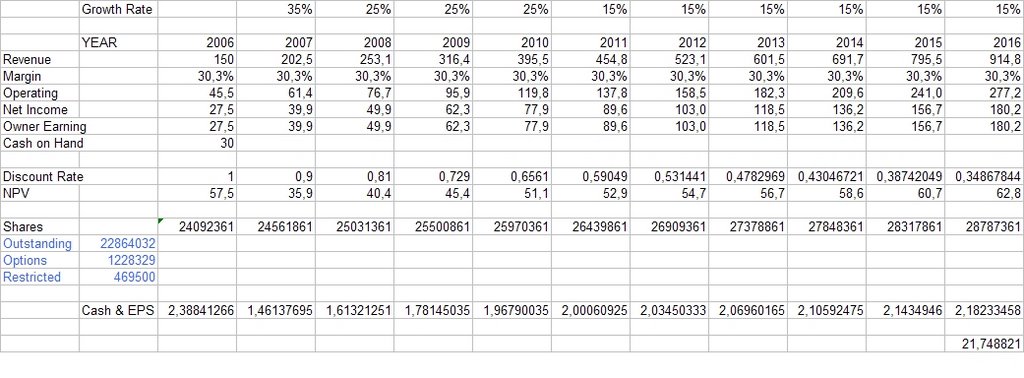
The model covers a ten year valuation of the company. Basically, what I have done is take the actual net cash and equivalents as of December 31, 2005, and the actual number of shares outstanding, plus the number of options outstanding, plus the number of restricted stock shares issued, and project the following: annual revenue growth, operating margins, tax rate, net income and owner earnings (net income plus depreciation less capital expenditures), and future equity dilution.
Starting with 2006, I project revenues of $150 million. This represents a 50% increase over last year's $102 million, and is roughly the amount that management projects. Going forward, I expect slower growth. It is possible that my growth rates are too conservative, but how mainstream can $300 jeans be? International sales are also flagging, though management has insisted that this will improve shortly. Management insists that it can turn the brand into a $1 billion per year business, though how long is not clear.
Next up is margins - a measure of how profitable those revenues are. The company appears to be consistently running an operating margin of 30.3%. It is important to distinguish between gross margins and operating margins. Gross margins is the spread between the sale price and the cost of the product sold, expressed as a percentage of the sale price. Thus, if sell for $300 a pair of jeans that cost you $150 to produce or purchase, your gross margin is 50%. However, there are still the other operating expenses, like employee, marketing, legal, and others, to pay. These are generally lumped together under Selling, General and Administrative expense. After you pay those expenses you arive at operating margins. That is, your profit as a percentage of sales after you have paid all operating expenses.
(Please note that the spreadsheet is in a German version of MS Excel, so don't be thrown by the commas. Germans use commas where US uses decimal points, and vice versa. Funny, isn't it? But I digress).
TRLG has benefitted from higher margins in recent months, expanding to about 52-53%. Most of this margin expansion is coming from the impact of retail stores, which enables the company to capture the additional gross profit between wholesale and retail. Unfortunately, it also means the company has proportionately higher selling, general and administrative expense, because there are rent, employees, utilities and other expenses to pay in operating that retail store, so operating margins are remaing about the same as before the retail stores. (The amount of revenue is higher, because revenue is now happening at retail, and not only at wholesale prices, so that margin is being earned on a higher top line number).
From there one has to consider interest expense (none, since the company has no debt, and appears to require no major investment to grow revenues, since all products are produced by contract manufacturers). This leads us to taxes. I assume a tax rate of 35% for all years. Here, I am simply projecting the current maximum corporate tax rate into the future. This is actually one area where I have not been conservative. It is likely that the US government will raise taxes, particularly on corporations, in the next 10 years, in order to combat rising deficits.
After the taxes are paid, we have Net Income. To this we need to add depreciation (a non-cash expense), and subtract capital expeditures. In mature businesses, these numbers are often very similar, as the business tends to need relatively little capital. What makes TRLG interesting is that it has virtually no cap-ex at all. In fact, it has virtually no long term capital commitments, other than some leasehold improvements at its corporate offices and retail stores.
So, Net Income and Owner Earnings are essentially the same.
The Discount Rate
One of the most crucial numbers you can chose in investing is an appropriate discount rate. The discount rate is used to reflect the time-value of money. Obviously, if I offered you $1 today or $1 in ten years, you would rather have the $1 today. I have to "discount" the value of the dollar in ten years to reflect the risks that you assume in waiting so long to get your money.
The first time they hear this, most people think of inflation, and in fact the idea is very similar. But where inflation measures the discount that would be required to maintain purchasing power, investors need to use a different number. We have to ask ourselves, what is the opportunity cost of the capital? Since if we didn't put our capital into this investment we could put it into a different one, we should really use a number that reflects what would happen if we were to earn the market return. I estimate this at about 10% (though in my first post I mentioned that the compounded rate of return of US stocks since 1926 is actually 9% - and that was in 1999 at the height of the bubble).
Once I have discounted those earnings into the future, I then need to divide the discounted earnings by the anticipated number of shares outstanding, so see how much earning power one share should have.
Thus far this year, management has cut out issuing itself options. Instead, it issues itself restricted stock. This year, the company issued employees 450,000 shares of restricted stock (it also issued some as settlement to outsiders). I see no reason to expect that management will become more frugal going forward, so I estimate the increase in shares outstanding by 469,000 per year. I then divide each year's discounted earnings by the anticipated shares outstanding.
All that is left to do is sum up the values. This produces a Net Present Value (reflecting the sum of all the present values) of the future cash flows of the company. Those cash flows are worth about $22.
Unlike most DCF models, I am assuming no residual value beyond the measurement period (generally, investments in stocks are considered to have infinite valuation periods, and you have to do that special calculation. In the case of this stock, where the true long term sustainability of the business is really a question it makes no sense to assume an infinite valuation period. The extra margin of safety is key).
Tuesday, September 26, 2006
I've left the temple of True Relgion
On Thursday, I unloaded my entire position in TRLG at $22.60. The stock hit an eight month high, near its all time high of $24.61, and this time I became concerned about valuation, and decided to take my 66.7% gain and run. The stock may head higher, but I believe that it will go lower again; indeed, it closed at $21.45 yesterday.
It should be noted, however, that evaluating an investment is an art, and not a science. While the math is straightforward, you have to make many estimates, because there are many possible outcomes. Buffett speaks of the need to have a range of values for a stock (and then watch developments and re-handicap the possible outcomes as events unfold). The quality of these estimates and the ability to estimate the probability of one of the outcomes over the other are the keys to success. So let’s break down my rationale for believing that the above estimate is approximately correct.
Reason 1: Valuation
The primary reason I sold was that my numbers told me to. I ran the numbers and concluded that the fair value of the stock is about $21-$22, so I sold at a slight premium to that value. As you can see from the embedded Discounted Cash Flow analysis, I estimate pretty strong revenue growth going forward, with ten years of growth above 15%. At the moment, the company is growing 50% over the prior year, but this is already a slower growth rate than 2005 was over 2004 (you can only compare the fourth quarter). As the revenue base continues to grow, I expect that in percentage terms revenue growth will continue to slow.
Revenue growth is the key to this company’s share price. The company’s price has almost nothing to do with the assets on its books. The price is entirely dependent on the expectation of future earnings growth. Thus, if earnings falter, even a little bit, the stock price is going to be hurt. Of course, that happens for all companies, but companies that have a market cap closer to their book values have a natural buoy to their share price – the fact that the assets on their books have value, and could be sold.
As of the second quarter, TRLG has $57 million in assets, against $7 million in liabilities. This is enough to get any investor’s attention. Better yet, $50 million of that is in current assets. The company has far more money in cash and short term investments than it has in liabilities. In short, the creditworthiness of the company is tremendous. In fact, almost none of its assets are actually used in the business. The company has about $20 million in working capital, and $2 million in property plant and equipment, substantially all of which is leasehold improvements at its corporate offices, warehouse and retail locations. In fact, the company appears to require no long term assets to run its business. This is a wonderful thing, in my mind, because its return on capital employed (ROCE), the capital actually used to run the business, is about 125%. These are the kind of numbers that had me buying at $13.50. But at that time, I estimated that the stock was conservatively worth $20 per share. While intrinsic value has grown somewhat (to almost $22), the market has come to value the company at that level, too. I don’t want to speculate on the market now overvaluing the company substantially, as betting on the market’s irrationality also requires me to bet on which direction that irrationality will take. Since by its nature the behavior would be irrational, it’s a fifty-fifty bet. I look for better odds.
The problem is, with $50 million in net assets, the company trades at over $500 million – for a price to tangible book of 10 times. The market is offering this company a tremendous amount of goodwill, because it is very well managed, but if there is even a small slowdown, Jim Cramer will be shouting “CLEAR!” as the price drops painfully. Since even well managed companies tend to miss “whisper” numbers on the Street (sometimes their very good management is actually the problem, as the Street gets too optimistic about management’s ability to deliver). I think this could happen in either the 4th quarter of this year or the 1st quarter of 2007.
It is also true that if revenue grows faster than I project, particularly in 2007 and 2008, the stock’s value should be higher. If operating margins were to increase, the company should also have higher intrinsic valuation. I don’t expect higher revenues (see reason three below) and I also don’t see higher operating margins (see reason four). It is also worth noting that there can be no assurance that the company’s products will remain fashionable for the next ten years, so future revenue growth could be negative, which would have a significant negative impact on the shares. Is the risk worth it?
Reason 2: Me
A successful investor has to control his own emotions. He also needs to know the limits of his competence – his circle of knowledge where he can make decisions better than others. In my case, TRLG does not fit that profile. This stock is really outside of my area of expertise. I purchased the stock not because I saw great visions for True Religion (though the company’s management does). I purchased the stock because I loved the growth rate and the balance sheet (check out the balance sheet on Yahoo or at your broker’s research site. It is as pristine as can be, with more cash than liabilities).
Back in early 2006, about 75 days after I purchased my shares, the stock hit an all-time high of $24.61. I decided not to sell, because I let the market convince me that I should trust my most aggressive estimates that showed an intrinsic value of $27-$30 a share. I was the fool in this case, since the stock then took a major dive, back down to $15. Had I sold, I could have bought back in when the stock hit that price point, which was a significant discount to my low-range value of $17 per share. I don’t want to make the same mistake again.
For what it’s worth, my lack of special knowledge means that I may be underestimating the company’s prospects. But I would rather underestimate them than overestimate them.
Macro Trends
While I lack special knowledge of fashion brands, I can see how macroeconomic factors will likely impact retail – negatively. The economy, while still strong, continues to slow. With a stabilization, or even decline of home prices, and the imminent retirement of spendthrift boomers, we face a high probability of declining consumer spending, which should put the entire category at risk. While the high-end of any market usually holds up best in a downturn (wealthy folks have wide, deep income streams), strong growth rates mean acquiring new, “mass affluent” customers. Faced with the need to save more, these folks are less likely to splurge on $300 jeans, so I expect that more aggressive growth rates that would further lift intrinsic value (and ultimately share price) are less probable than the rates reflected in my DCF analysis.
Company specific issues
Apart from the foregoing, TRLG has some other company-specific risks. The stock is controlled by a single shareholder, who also happens to be the CEO. In fact, insiders control a significant amount of the stock, and therefore not only have control of management, they also control the board. While this is not necessarily a problem, after all, some of the best run companies in the world are controlled by single shareholders, it is even more important than with other companies to see if management is acting in the interests of all shareholders.
While management appears to be running the business well, they are taking steps that are not nearly as shareholder friendly. While they have stopped issuing options (the remainder of which will eventually be exercised, rest assured), they are instead issuing large amounts of restricted stock. Thus, as shareholders, we are seeing our slice of the pie get smaller. The pie is getting bigger at a very fast pace, so the size of our slice is getting larger, but it is doing so by getting thinner and longer. I like to look for companies that are net-repurchasers of stock. That is, the repurchase more than they issue (including options). That way, I know that my slices are getting wider as well as longer.
True Religion is not doing so. They are not repurchasing stock, nor are they issuing even a small dividend. While this is not uncommon among small fast-growing companies, TRLG has demonstrated that it doesn’t need additional assets to fund its growth. No where has TRLG indicated that it has definite capital plans that might require the cash to be reinvested in the business. So why not return cash to shareholders?
Likewise, why pay employees with stock? Why not pay them cash bonuses (from current year revenues). This will reduce the cash-hoard slightly, but again, the cash doesn’t seem to be required. Employees can purchase the stock in the open market if they consider it such a value.
Finally, when management controls a company like this one and cash starts piling up, management gets all sorts of ideas about various projects that would be interesting to undertake. Usually these ventures produce far lower returns than the business itself, and ultimately destroy value. With no real checks to prevent this, as a shareholder I must be concerned about the uses to which the cash will be put.
Market environment
TLRG has been a favorite stock of the shorts. As of August 10, it had nearly 40% of the float sold short. This, ironically, is often a bullish signal. Since the short shares have to be bought back, large short positions guarantee future purchase volume (though not higher prices). However, as the stock has been rallying in the last few weeks, various shorts have undoubtedly been closing their short positions by repurchasing the shares, potentially at a loss, as the stock market has rallied, rather than faltered, during this unusual third quarter.
Once that short-covering purchase demand dries up, however, we are likely to see a downward drift in the price. Some shorts, convinced that technical factors will drive the stock down to the mid-teens again, will start selling short again. Such a reversal is likely to see us head lower.
The bullish case
The bulls can argue that revenue growth will remain strong (the third quarter is the biggest, revenue wise for the company. If we see continued strong growth in the
However, the bullish case also relies on continued short squeezing, and potentially on a sale of the company. I believe that, at current valuation, no such sale is likely. An acquirer would get some cash, the trademarks, and a heap of goodwill. And that is BEFORE paying a takeover premium. Similarly, an effort to take the company private, which is possible because insiders could commit their stock, would still require significant amounts of debt, at least $300 million worth, which the company could probably pay, but would significantly impair net revenues, as the interest payments would be on a scale comparable to operating earnings.
Sunday, September 17, 2006
What's your Sloth Story
Tell us about your story of successful "slothful" investing. Maybe your grandmother leave you shares of XOM or GE? Or you got in on the Google IPO and are still holding (or MSFT?)
We'll take stories slothful waste as well.
Mine actually involves using a full service broker. My parents are successful people, but not what you would call successful investors. They are employees who have saved diligently and profited from the long bull market.
Anyway, when I was 12 (and definately no investor), I decided I wanted to purchase stocks. So my dad took me to Merrill Lynch (which a savvier investor would not have done) and helped me open an account. At the time Merrill was offering a program that enabled you to purchase based on dollar increments and not round lots (which I could not afford). I decided to invest in the bluest of blue chips. T. Yes, American Telephone & Telegraph. I purchased 7 plus shares with about $200.
I was excited about the dividend and the strength of the company. After 12 years I had shares in Lucent, AT&T, NCR, Comcast, Avaya, Agere and other companies. I think my position was worth nearly $1000, which wasn't bad. But I had never really collected any dividends because of the account fees. When the telecom market collapsed, I wound up with an account balance not significantly different from my initial investment and I still had fees I owed.
I sure had been slothful, but I had missed the boat.
We'll take stories slothful waste as well.
Mine actually involves using a full service broker. My parents are successful people, but not what you would call successful investors. They are employees who have saved diligently and profited from the long bull market.
Anyway, when I was 12 (and definately no investor), I decided I wanted to purchase stocks. So my dad took me to Merrill Lynch (which a savvier investor would not have done) and helped me open an account. At the time Merrill was offering a program that enabled you to purchase based on dollar increments and not round lots (which I could not afford). I decided to invest in the bluest of blue chips. T. Yes, American Telephone & Telegraph. I purchased 7 plus shares with about $200.
I was excited about the dividend and the strength of the company. After 12 years I had shares in Lucent, AT&T, NCR, Comcast, Avaya, Agere and other companies. I think my position was worth nearly $1000, which wasn't bad. But I had never really collected any dividends because of the account fees. When the telecom market collapsed, I wound up with an account balance not significantly different from my initial investment and I still had fees I owed.
I sure had been slothful, but I had missed the boat.
The Slothful Investor
As Empty Spaces, who writes the tremendous blog, Adventures in Moneymaking (go check it out), notes in a comment to my last post, Warren Buffett remarks that successful investing consists of long periods of inactivity, bordering on sloth. So, perhaps I should have titled this blog The Slothful Investor, since this accurately describes my trading activity.
Before I continue, however, I would like to give a shout to the Oracle of Omaha, who finally married his long-term girlfriend. For those who do not know, the Buffetts separated in 1977, but incredibly never divorced. Susan Thomson Buffett, Warren's late wife, remained on the board of Berkshire, and by not going through divorce proceedings enabled him to keep control of Berkshire. With her death in 2004, however, the Oracle has changed his plans for his fortune and has decided to finally tie the knot with Astrid Menks.
Back to the issue of sloth, however. Slothful investing is the natural correlary of focus investing. Since your few best ideas are going to be much better than your other ideas, you spend alot of time just sitting on your existing positions and looking for something better. Only occasionally will you find it. Isn't this a major reason why trading is so much work? Following the market obsessively takes huge amounts of time. Worse, much like executive focus on meeting the quarterly numbers, it takes your focus off of what really counts - the intrinsic value of the businesses. Much, much worse, it tends to generate fees. Lots and lots of fees.
Buffett as a Slothful Investor
The best example of sloth I know is Buffett's purchase of the Washington Post in the early 1970s. This stock gets far less play than his investments in Coca-Cola, Geico, or even L3 Communications (a position that has since been liquidated). To understand this purchase, zou have to appreciate the publishing business and Buffett's timing.
Unlike most public companies, nearly all media outfits are controlled by a family or major shareholder. This is true regardless of the medium, everything from television (CBS, Fox) to to newsprint (NYT, Wall Street Journal, Washington Post, USAToday). Most newpaper companies operate with multiple classes of stock. This is the result of the fact that most of these companies were originally closely held family businesses. When they went public, the family wanted to make sure that it could maintain editorial control. Unusually for companies with multiple classes of stock, this has probably benefitted shareholders. News outlets obviously have editorial slants and their readers are often motivated to purchase that content based on their own views. A sudden change of control, and concomitant change of editorial direction could have readers scrambling for the exits. (Can you imagine the shrill cries of Daily Kos if the NYT were acquired by Rupert Murdoch?) So protecting the editorial direction is part of protecting the franchise.
But back to 1973. Buffett valued the company at $400 million. In one of his annual reports, he notes that anyone he asked felt the company was worth $400 million. Mr. Market was asleep that day, because it was valued at $80 million. Buffett purchased $11 million in a tender offer, which gave him a 15% share of the Class B stock.
He wanted to purchase more, but Katherine Graham, the publisher who had IPOed the paper after the death of her husband and ran it for years, was influenced by her son who felt that no one but the Graham family should have a larger share. Sticking with his strategy of investing only with management he likes, he complied with their request. (I actually had the tremendous pleasure of sharing a limo with Mrs. Graham on two occasions. She received the Benton Medal from the University of Chicago, my alma mater, and I was working in the office of special events. I picked her up at the airport and took her to the president's house. When she departed, I shared breakfast with Mrs. Graham, the University president and his wife, and then rode in the limo back with her. She was quite a conversationalist and down to earth.)
Today, his 1.7 million share position is worth $1.4 Billion ! The stock also continues to pay a solid dividend. At $7.80 per share, the annual dividend that Buffett collects exceeds his initial investment, and he has been able to use it to invest in other projects over the years. This one investment counts for the bulk of the tremendous outperformance of Berkshire since 1965. He has never sold shares in the company. Essentially, he has been able to sit on the position and experience rising dividends.
Life as a Slothful Investor
The best thing about slothful investing is that it enables you to live your life. Once your investments are on autopilot, you can focus on the things that are really important to you, like travel, or education, or your family.
In my case, I made very few moves last year. My three big changes were to liquidate a position in a small cap mutal fund. I sold FBRVX and kept PRCGX. While this hasn't been a horrible decision, it turns out I would have been better off with the FBR fund (I orginally purchase in 2001 and had made no move since). I sold it becuase I wanted to reduce my exposure to small cap funds.
Instead, I decided to make a "major purchase" of 200 shares of BAC. I will cover this in more detail in another post, but basically I purchased it because the stock was cheap, large cap financials were unloved, I expected a rally after the Fed stopped raising rates, and I was going to be paid handsomely to wait. I purchased in the mid 40s and one year later we are around $51, but I have also collected the dividends.
Finally I made a purchase in November that turns out to be my one position where trading would really have helped. TRLG is one of my favorite companies. Since we are now $10 above where I purchased last November, I need to reevaluate this stock, but had I traded, I could have sold at $24 only weeks after purchasing at $13. I could then have repurchased the stock at $15 and rode it all again to $22 where we are now. But the truth is, I am not looking to call tops or bottoms. I am simply looking to purchase dollars on the cheap.
I have not made a trade in nearly a year. Still, I am up over 20% since this time last year. My limited work on this has enabled me to refocus on my quadrant "e" work, apply and get accepted to business school, sail and still find a little time to remind my girlfriend why she is so important to me. (Ok, I could do better on this last point).
Before I continue, however, I would like to give a shout to the Oracle of Omaha, who finally married his long-term girlfriend. For those who do not know, the Buffetts separated in 1977, but incredibly never divorced. Susan Thomson Buffett, Warren's late wife, remained on the board of Berkshire, and by not going through divorce proceedings enabled him to keep control of Berkshire. With her death in 2004, however, the Oracle has changed his plans for his fortune and has decided to finally tie the knot with Astrid Menks.
Back to the issue of sloth, however. Slothful investing is the natural correlary of focus investing. Since your few best ideas are going to be much better than your other ideas, you spend alot of time just sitting on your existing positions and looking for something better. Only occasionally will you find it. Isn't this a major reason why trading is so much work? Following the market obsessively takes huge amounts of time. Worse, much like executive focus on meeting the quarterly numbers, it takes your focus off of what really counts - the intrinsic value of the businesses. Much, much worse, it tends to generate fees. Lots and lots of fees.
Buffett as a Slothful Investor
The best example of sloth I know is Buffett's purchase of the Washington Post in the early 1970s. This stock gets far less play than his investments in Coca-Cola, Geico, or even L3 Communications (a position that has since been liquidated). To understand this purchase, zou have to appreciate the publishing business and Buffett's timing.
Unlike most public companies, nearly all media outfits are controlled by a family or major shareholder. This is true regardless of the medium, everything from television (CBS, Fox) to to newsprint (NYT, Wall Street Journal, Washington Post, USAToday). Most newpaper companies operate with multiple classes of stock. This is the result of the fact that most of these companies were originally closely held family businesses. When they went public, the family wanted to make sure that it could maintain editorial control. Unusually for companies with multiple classes of stock, this has probably benefitted shareholders. News outlets obviously have editorial slants and their readers are often motivated to purchase that content based on their own views. A sudden change of control, and concomitant change of editorial direction could have readers scrambling for the exits. (Can you imagine the shrill cries of Daily Kos if the NYT were acquired by Rupert Murdoch?) So protecting the editorial direction is part of protecting the franchise.
But back to 1973. Buffett valued the company at $400 million. In one of his annual reports, he notes that anyone he asked felt the company was worth $400 million. Mr. Market was asleep that day, because it was valued at $80 million. Buffett purchased $11 million in a tender offer, which gave him a 15% share of the Class B stock.
He wanted to purchase more, but Katherine Graham, the publisher who had IPOed the paper after the death of her husband and ran it for years, was influenced by her son who felt that no one but the Graham family should have a larger share. Sticking with his strategy of investing only with management he likes, he complied with their request. (I actually had the tremendous pleasure of sharing a limo with Mrs. Graham on two occasions. She received the Benton Medal from the University of Chicago, my alma mater, and I was working in the office of special events. I picked her up at the airport and took her to the president's house. When she departed, I shared breakfast with Mrs. Graham, the University president and his wife, and then rode in the limo back with her. She was quite a conversationalist and down to earth.)
Today, his 1.7 million share position is worth $1.4 Billion ! The stock also continues to pay a solid dividend. At $7.80 per share, the annual dividend that Buffett collects exceeds his initial investment, and he has been able to use it to invest in other projects over the years. This one investment counts for the bulk of the tremendous outperformance of Berkshire since 1965. He has never sold shares in the company. Essentially, he has been able to sit on the position and experience rising dividends.
Life as a Slothful Investor
The best thing about slothful investing is that it enables you to live your life. Once your investments are on autopilot, you can focus on the things that are really important to you, like travel, or education, or your family.
In my case, I made very few moves last year. My three big changes were to liquidate a position in a small cap mutal fund. I sold FBRVX and kept PRCGX. While this hasn't been a horrible decision, it turns out I would have been better off with the FBR fund (I orginally purchase in 2001 and had made no move since). I sold it becuase I wanted to reduce my exposure to small cap funds.
Instead, I decided to make a "major purchase" of 200 shares of BAC. I will cover this in more detail in another post, but basically I purchased it because the stock was cheap, large cap financials were unloved, I expected a rally after the Fed stopped raising rates, and I was going to be paid handsomely to wait. I purchased in the mid 40s and one year later we are around $51, but I have also collected the dividends.
Finally I made a purchase in November that turns out to be my one position where trading would really have helped. TRLG is one of my favorite companies. Since we are now $10 above where I purchased last November, I need to reevaluate this stock, but had I traded, I could have sold at $24 only weeks after purchasing at $13. I could then have repurchased the stock at $15 and rode it all again to $22 where we are now. But the truth is, I am not looking to call tops or bottoms. I am simply looking to purchase dollars on the cheap.
I have not made a trade in nearly a year. Still, I am up over 20% since this time last year. My limited work on this has enabled me to refocus on my quadrant "e" work, apply and get accepted to business school, sail and still find a little time to remind my girlfriend why she is so important to me. (Ok, I could do better on this last point).
Wednesday, August 09, 2006
How Wealthy do you Want to Be?
Publishing magnate Felix Dennis has established the following wealth scale in an article published online in the Sunday Times (London). I guess my old objective was to be in the comfortably wealthy camp ($10 million US is approximately 6.8 million British pounds). But are there really so many levels?
I wonder, th0ugh, how this scale might look were it based on income (or cash flow). What do you think? At what point does additional income cease to make a difference, since it really increases neither your control of your time nor your standard of living?
For me, of course, I still measure wealth in time. One thing is certain, though. If you aren't born to wealth, then the only way to get to the other levels is to get control of your time, and use it to focus on expanding your wealth.
Dennis's Wealth Scale
I wonder, th0ugh, how this scale might look were it based on income (or cash flow). What do you think? At what point does additional income cease to make a difference, since it really increases neither your control of your time nor your standard of living?
For me, of course, I still measure wealth in time. One thing is certain, though. If you aren't born to wealth, then the only way to get to the other levels is to get control of your time, and use it to focus on expanding your wealth.
Dennis's Wealth Scale
Total assets
£1m-£2m The comfortable poor
£2m-£5m The comfortably off
£5m-£15m The comfortably wealthy
£15m-£40m The lesser rich
£40m-£75m The comfortably rich
£75m-£100m The rich
£100m-£200m The seriously rich
£200m-£400m The truly rich
£400m-£999m The filthy rich
More than £999m The super rich
Thursday, July 06, 2006
Retirement Calculator
I came across a new "retirement calculator" from A.G. Edwards. (Read the press release) The scoring is based on the idea of credit scores, with ranks between 450-850. Anthing over 750 is considered excellent, 650-749 is good, 550-649 is fair and below 550 poor.
You answer 14 questions, including age, income, work years, home equity, savings and the like and it assesses the strength of your nest egg.
Your humble writer came in at 738, but mostly, I believe, because I do not own a home.
I like it because it compares you to other households, but my complaint is that unlike credit scoring, which have a predictive value (they tell a lender how likely you are to be late on a payment), A.G. Edwards offers no probability that you will reach retirement with x% of income. They also do not ask what your retirement goal is. Still it is worth checking out.
You answer 14 questions, including age, income, work years, home equity, savings and the like and it assesses the strength of your nest egg.
Your humble writer came in at 738, but mostly, I believe, because I do not own a home.
I like it because it compares you to other households, but my complaint is that unlike credit scoring, which have a predictive value (they tell a lender how likely you are to be late on a payment), A.G. Edwards offers no probability that you will reach retirement with x% of income. They also do not ask what your retirement goal is. Still it is worth checking out.
Monday, July 03, 2006
Retirement: How Much do you REALLY Need?
In my previous post, I noted that I believed that a sensible target for being able to retire (this applies even more if you want to retire early) is to plan to have significantly more income in retirement than when you are working. This enables one to have more "walking around money" to pay for leisure time activities. I have found further evidence of this at the end of the Retirement Report from the EBRI.
The report found that while most workers believe they can live on something like 60-80% of pre-retirement income (and assume that they can live well, since their retired parents appear to have far less income), more than half of retirees actually reported equal or greater income in retirement than when they were working. with one in five reporting higher income. Today's workers believe that they can have a retirement at least as comfortable as their parents, because a) they have earned more throughout their lives, b) they have a large home and c) their parents appear to do fine on low incomes. The problem with this logic is one of competition for services. Todays retirees compete with other low-income retirees for "retiree services". Many of their actual expenses (especially taxes and healthcare) are heavily subsidized by todays workers. Those subsidies may not be available tomorrow, and today's "high-income" workers will find that they are competing for services with other retirees with similar circumstances, so prices for those sevices will likely rise above present levels.
Finally, it is important to note that while today's retirees seem poor compared to their boomer children (at peak earnings), they find themselves in a lifestyle with which they were accustomed. Thus, their needs and wants are simply lower. Todays workers will find the experience far more jarring, and sadly, they may actually not have more income in retirement than their parents do today (while still facing higher prices). Unlike their parents, who won all sorts of subsidies to keep themselves in their houses, todays workers may find that they need to sell their house just to provide income for basic necessities in retirement (thus eviscerating the value of the tax subsidy for which they would otherwise be eligible).
This is why my personal monthly investing cashflow target includes a cushion that significantly exceeds my current net income (not to mention my expenses, which are at this time a fraction of my net income). I have built this cushion into my model to allow for three things. The first is inflation. It will take some time (at my current pace at least) to build this passive income and I want to protect my purchasing power. Second, I want to have walking around money. What is the fun of being a full-time investor, if you can't take advantage of opportunities to use the time-flexibility that investing offers. Third, and most important, I want to ensure that I have streams of income to serve as further capital to make investments.
Indeed, if you are fortunate enough to be able to retire in your mid-50s (or younger), you should plan to expand your capital base. The reason for this is simple. You will need to plan for a rising income in retirement to keep up with inflation (or even better, wages). There are two ways to do so, either you increase the returns on capital invested, or increase the amount of capital invested. Unless you can assume higher risk of loss in retirement than when you were working (unlikely for most people), you had better assume lower returns on capital, and lots more of it.
I am curious to know how others are preparing for retirement. What strategies are you using? How prepared are you?
The report found that while most workers believe they can live on something like 60-80% of pre-retirement income (and assume that they can live well, since their retired parents appear to have far less income), more than half of retirees actually reported equal or greater income in retirement than when they were working. with one in five reporting higher income. Today's workers believe that they can have a retirement at least as comfortable as their parents, because a) they have earned more throughout their lives, b) they have a large home and c) their parents appear to do fine on low incomes. The problem with this logic is one of competition for services. Todays retirees compete with other low-income retirees for "retiree services". Many of their actual expenses (especially taxes and healthcare) are heavily subsidized by todays workers. Those subsidies may not be available tomorrow, and today's "high-income" workers will find that they are competing for services with other retirees with similar circumstances, so prices for those sevices will likely rise above present levels.
Finally, it is important to note that while today's retirees seem poor compared to their boomer children (at peak earnings), they find themselves in a lifestyle with which they were accustomed. Thus, their needs and wants are simply lower. Todays workers will find the experience far more jarring, and sadly, they may actually not have more income in retirement than their parents do today (while still facing higher prices). Unlike their parents, who won all sorts of subsidies to keep themselves in their houses, todays workers may find that they need to sell their house just to provide income for basic necessities in retirement (thus eviscerating the value of the tax subsidy for which they would otherwise be eligible).
This is why my personal monthly investing cashflow target includes a cushion that significantly exceeds my current net income (not to mention my expenses, which are at this time a fraction of my net income). I have built this cushion into my model to allow for three things. The first is inflation. It will take some time (at my current pace at least) to build this passive income and I want to protect my purchasing power. Second, I want to have walking around money. What is the fun of being a full-time investor, if you can't take advantage of opportunities to use the time-flexibility that investing offers. Third, and most important, I want to ensure that I have streams of income to serve as further capital to make investments.
Indeed, if you are fortunate enough to be able to retire in your mid-50s (or younger), you should plan to expand your capital base. The reason for this is simple. You will need to plan for a rising income in retirement to keep up with inflation (or even better, wages). There are two ways to do so, either you increase the returns on capital invested, or increase the amount of capital invested. Unless you can assume higher risk of loss in retirement than when you were working (unlikely for most people), you had better assume lower returns on capital, and lots more of it.
I am curious to know how others are preparing for retirement. What strategies are you using? How prepared are you?
Saturday, July 01, 2006
Retirement Crisis
This blog is about investing strategy, but it is important to realize that strategies support goals. One of the most important for everyone (including your humble writer) is retirement. While I have noted that my goals have changed from a retirement-centered net worth model to a cashflow-centered investment model, my strategy involves a plan to be able to retire, even if I fail to meet my primary investing objectives.
It is therefore saddening to read in todays Wall Street Journal that the Employee Benefit Research Institute has found that most Boomers believe that they are well prepared for retirement, and yet, have failed to save for it. Most workers are literally planning to be poor in retirement, which I consider to be a very bad strategy indeed.
Before we dig a bit deeper into the findings of the report, I want to note that I believe the only intelligent strategy for retirement planning is to expect to need MORE MONEY in retirement than you need when you are working. I realize that my target it iconclastic, and contradicts conventional retirement planning wisdom. The conventional wisdom is simply unwise.
Here's why: free time is expensive. I went to the barber this morning, and in the course of the normal bullshitting that goes on, I asked if they were going to take Monday off to make a three day weekend out of it (in Bergen County, New Jersey, blue laws prohibit most businesses from being open on Sundays, and Tuesday is the 4th of July). He mentioned that, no, it was a normal week, apart from Tuesday the Fourth. Then, sagely, he remarked, "If we had the day off, I'd just spend money. You know, you do a few things, and you ask yourself, where did it all go?" This is exactly the problem. If you are the ueber-achiever that I suspect most readers of this blog are, you currently work something north of 45-48 hours a week (plus commuting time). What will you do when you are no longer working? No doubt, you will volunteer or find other "low-cost" activities like blogging to fill your time, but how many of us also want to travel, have a second home play golf at nice courses and/or own a boat? (Personally, I find that you can either sail, or golf, but not both there simply isn't enough time. Maybe, in retirement I will find a way).
The secret of retirement is, free time is expensive. Since so many of us are reaching retirement healthier than former generations, we will want to do more active things, not spend time playing bocce in retirement communities and sitting by the pool complaining about Medicare (though I suspect that many will do so).
Of course, you could always work. In fact, the concept of retirement is really a relatively new creation. Before Bismarck created state pensions in Germany in the 1880s, almost no one retired. According to the study, many people (67% of workers, actually) expect to work in retirement. This will help to mitigate the expensive free-time problem and it will provide some income, but most of the jobs that people expect to do will not replace their peak earning incomes.
And any Boomer who falls ill will likely run through their meagre savings quickly, since they do not have the same retirement benefits offered to those born before 1940.
Since most people are failing to meet even the insufficient standards of preparation suggested by the retirement planning industry, as investors, we need to consider how we can protect ourselves (and profit) from Boomer financial folly. Make no mistake, since profligate Boomer spending has been a major driver of economic activity in the US and the world, when it comes time to pay the piper, Boomer spending habits will cause significant upheaval in the markets.
So what does the report actually suggest? You can read it in its entirety here. The survey was of 1252 American adults over 25 (1000 workers and 252 retirees) in 21-minute telephone interviews.
The scariest finding is that 30% of people saving nothing for retirement and that of those, 44% of believed that they would have a comfortable retirement, because of money from employers, inheritance and "faith".
Even though only 40% of people had a defined-benefit (traditional pension) plan 61% expected to receive benefits from one!
More than half had saved less than $50,000 for retirement. It should be noted that the youngest workers cannot be expected to have saved large amounts, and the oldest workers are likely to have additional income from a traditional pension. Current retirees have about 3x their salaries in savings when they retire. Still, what does it say about people's spending habits that they have essentially saved NOTHING? How can they expect to live on much less than their salary, when they are consuming all of it today? Remember, free time is expensive! Even traditional retirement formulas that assume a good target is 80% of pre-retirement income begin with the presumption that much of that 20% differential represents pre-retirement savings. That is, just before retirement, you are already living on only 80% of your income, because of savings. Once you retire, you can stop saving, so you essentially have the same standard of living in retirement that you had just before it.
Finally, 42% of workers have not made even an estimate of their needs in retirement, so it is no surprise that they are confident and unprepared. 22% of very confident people are not currnetly saving for retirement, 39% have less than $50,000 saved, and 37% have made no estimate of how much they need. Ignorance is bliss, but like faith, it is not a good retirement strategy.
So, what can you do to protect yourself and profit from this coming generational debacle? Well this writer fully expects a major asset-price collapse, a collapse that will be compounded by an effort among central banks to deflate the asset bubble their easy money has created.
You must protect capital in stable-value, even insured, products. In a demand driven deflation like the 1930s, cash is king.
If you are nearing retirement, consider (even with seemingly low interest rates) putting some of your nest egg into a single premium immediate annuity, which will guarantee income for life. Do this with a highly rated insurer, as weaker insurers will likely default in an asset-price crash.
Reconsider your equity investments carefully. In a major economic downturn, consumer staples will hold up best. Make sure that the companies whose stocks you purchase are not highly leveraged, as falling prices will make it dificult to generate sufficient cash flows for debt service. Count your dividends. These are real returns, and retirees will need the dividend income, so such stocks will be the least hard hit.
Think high taxes. As government revenues fall, making a bad fiscal picture absolutely terrifying, governments will look to raise taxes everywhere, but especially on incomes and businesses (though, in an effort to placate angry, near-destitute retirees (voters), they will likely continue to keep them low on investment income). Think about ways to generate income from investments.
Consider international investments in countries with better demographics and favorable economic conditions. Note: China does NOT have favorable demographics and will be very hard hit in a major downturn as outlined above.
Sorry for the gloom and doom. I am really an optimistic person (I guess I count myself among the "very confident" crowd). But whenever I see numbers like these, I am truly dismayed. I believe that the Boomers are fomenting an economic boom and crisis much like that of the 1920s and 1930s, when the last "idealist" generation - that of Hoover and FDR - hit retirement. Already we are seeing Smoot-Hawley tariff style protectionism. A collapse in global trade, forcing consumer prices up, together with a collapse in asset prices, driving purchasing power down, is a recepie for disaster.
It is therefore saddening to read in todays Wall Street Journal that the Employee Benefit Research Institute has found that most Boomers believe that they are well prepared for retirement, and yet, have failed to save for it. Most workers are literally planning to be poor in retirement, which I consider to be a very bad strategy indeed.
Before we dig a bit deeper into the findings of the report, I want to note that I believe the only intelligent strategy for retirement planning is to expect to need MORE MONEY in retirement than you need when you are working. I realize that my target it iconclastic, and contradicts conventional retirement planning wisdom. The conventional wisdom is simply unwise.
Here's why: free time is expensive. I went to the barber this morning, and in the course of the normal bullshitting that goes on, I asked if they were going to take Monday off to make a three day weekend out of it (in Bergen County, New Jersey, blue laws prohibit most businesses from being open on Sundays, and Tuesday is the 4th of July). He mentioned that, no, it was a normal week, apart from Tuesday the Fourth. Then, sagely, he remarked, "If we had the day off, I'd just spend money. You know, you do a few things, and you ask yourself, where did it all go?" This is exactly the problem. If you are the ueber-achiever that I suspect most readers of this blog are, you currently work something north of 45-48 hours a week (plus commuting time). What will you do when you are no longer working? No doubt, you will volunteer or find other "low-cost" activities like blogging to fill your time, but how many of us also want to travel, have a second home play golf at nice courses and/or own a boat? (Personally, I find that you can either sail, or golf, but not both there simply isn't enough time. Maybe, in retirement I will find a way).
The secret of retirement is, free time is expensive. Since so many of us are reaching retirement healthier than former generations, we will want to do more active things, not spend time playing bocce in retirement communities and sitting by the pool complaining about Medicare (though I suspect that many will do so).
Of course, you could always work. In fact, the concept of retirement is really a relatively new creation. Before Bismarck created state pensions in Germany in the 1880s, almost no one retired. According to the study, many people (67% of workers, actually) expect to work in retirement. This will help to mitigate the expensive free-time problem and it will provide some income, but most of the jobs that people expect to do will not replace their peak earning incomes.
And any Boomer who falls ill will likely run through their meagre savings quickly, since they do not have the same retirement benefits offered to those born before 1940.
Since most people are failing to meet even the insufficient standards of preparation suggested by the retirement planning industry, as investors, we need to consider how we can protect ourselves (and profit) from Boomer financial folly. Make no mistake, since profligate Boomer spending has been a major driver of economic activity in the US and the world, when it comes time to pay the piper, Boomer spending habits will cause significant upheaval in the markets.
So what does the report actually suggest? You can read it in its entirety here. The survey was of 1252 American adults over 25 (1000 workers and 252 retirees) in 21-minute telephone interviews.
The scariest finding is that 30% of people saving nothing for retirement and that of those, 44% of believed that they would have a comfortable retirement, because of money from employers, inheritance and "faith".
Even though only 40% of people had a defined-benefit (traditional pension) plan 61% expected to receive benefits from one!
More than half had saved less than $50,000 for retirement. It should be noted that the youngest workers cannot be expected to have saved large amounts, and the oldest workers are likely to have additional income from a traditional pension. Current retirees have about 3x their salaries in savings when they retire. Still, what does it say about people's spending habits that they have essentially saved NOTHING? How can they expect to live on much less than their salary, when they are consuming all of it today? Remember, free time is expensive! Even traditional retirement formulas that assume a good target is 80% of pre-retirement income begin with the presumption that much of that 20% differential represents pre-retirement savings. That is, just before retirement, you are already living on only 80% of your income, because of savings. Once you retire, you can stop saving, so you essentially have the same standard of living in retirement that you had just before it.
Finally, 42% of workers have not made even an estimate of their needs in retirement, so it is no surprise that they are confident and unprepared. 22% of very confident people are not currnetly saving for retirement, 39% have less than $50,000 saved, and 37% have made no estimate of how much they need. Ignorance is bliss, but like faith, it is not a good retirement strategy.
So, what can you do to protect yourself and profit from this coming generational debacle? Well this writer fully expects a major asset-price collapse, a collapse that will be compounded by an effort among central banks to deflate the asset bubble their easy money has created.
You must protect capital in stable-value, even insured, products. In a demand driven deflation like the 1930s, cash is king.
If you are nearing retirement, consider (even with seemingly low interest rates) putting some of your nest egg into a single premium immediate annuity, which will guarantee income for life. Do this with a highly rated insurer, as weaker insurers will likely default in an asset-price crash.
Reconsider your equity investments carefully. In a major economic downturn, consumer staples will hold up best. Make sure that the companies whose stocks you purchase are not highly leveraged, as falling prices will make it dificult to generate sufficient cash flows for debt service. Count your dividends. These are real returns, and retirees will need the dividend income, so such stocks will be the least hard hit.
Think high taxes. As government revenues fall, making a bad fiscal picture absolutely terrifying, governments will look to raise taxes everywhere, but especially on incomes and businesses (though, in an effort to placate angry, near-destitute retirees (voters), they will likely continue to keep them low on investment income). Think about ways to generate income from investments.
Consider international investments in countries with better demographics and favorable economic conditions. Note: China does NOT have favorable demographics and will be very hard hit in a major downturn as outlined above.
Sorry for the gloom and doom. I am really an optimistic person (I guess I count myself among the "very confident" crowd). But whenever I see numbers like these, I am truly dismayed. I believe that the Boomers are fomenting an economic boom and crisis much like that of the 1920s and 1930s, when the last "idealist" generation - that of Hoover and FDR - hit retirement. Already we are seeing Smoot-Hawley tariff style protectionism. A collapse in global trade, forcing consumer prices up, together with a collapse in asset prices, driving purchasing power down, is a recepie for disaster.
Subscribe to:
Posts (Atom)